on humanism and environmental crisis

Archive for the ‘nature of reality’ Category

Stories about the invention of language

The stories that help us understand “The invention of language as an ultimate culprit for the environmental and social crisis.”

I liked this essay, but my friends think it could be better. Some conclusions and assumptions were too hastily made. The text was too dry and not personal. My persona, apparently, was too pushy and annoying, as I would act as “the strident scientist who knows all.”

  The language was invented by humans very late, as a simple communication social tool. With the recent dominance of the left hemisphere, it crazily determines our reality.

   Danka was an incredible woman. The times must have been ready for a big, almost magical transformation in the living beings on Earth.

She lived about 50,000 years ago in the hunter-gatherer group somewhere in Eastern Turkey. During her single long life, she witnessed and participated in the invention of a new communication method.  As a toddler, she was saved from a tiger attack by possibly the last surviving Neanderthal, Adam. Later, Adam, recovering after the fight with the tiger, observed little Danka learning to communicate, pointing at objects trying to repeat the sounds. Adam was unusually motivated, loved The Beautiful, Danka’s big sister, and wanted to understand and belong.

The life of these people was simple and routine; it was about executing inborn instincts prompted by a changing environment. Sun was rising, and the men went hunting gazelles, which were plentiful there. The women did the rest- gather nuts, wild grain, and fruit.  Everybody helped with caring for the children, grooming, and making stone tools.

 The desires were simple: safety, warmth, belonging, food, mating, and social position. Algorithms and neurotransmitters determined the actions and planning, felt subjectively what we would call “wants, fears, and pleasures.”

  When I go for a morning walk with my dog, Tex, it is pretty much the same. The clouds moved away, and the sun is shining in Tennessee. I am breathing, walking, and enjoying the park around me. The dog is happy; he feels pretty much the same.

  No words. He sees me happy; I see him happy. We think about the breakfast we will have on return. I will cook eggs; Tex will have his pellets. I feel alive, slightly cold, though, and getting hungry. We both think about breakfast, and we both know what to do and what will happen: some vague images coming to mind: “inside the fridge’, “cutting tomatoes,” “Remember the toasts!” and such. You can imagine that these images and thoughts are the pieces of larger instinctual and learned sequences of instructions in my brain. The events in Tex’s mind are pretty much the same: happy on the walk, chilled, hungry, expecting to be fed on return, all parts of instinctual algorithms and learned routines.

   Deep in my “breakfast reverie’ I am startled by the sudden: “Hello, Tom!”. I bumped into Sam, an old friend of mine, with his dog.

“Hello, Sam, “I exclaimed, “what are you doing here?”.

Normal? Well, it looked normal, but it was a neural tsunami.

Until now, both I and my dog utilized our basal ganglia- like the amygdala, and brain stem, maybe some hippocampal memories.

Suddenly (without a second of hesitation), I started to use language. I jumped into a completely separated reality full of people, things, and ideas- all generated in Broca’s and Wernicke’s areas while the previous animal system was still active. I was merging both of my realities seamlessly and effortlessly.

Tex was left utterly alone, now playing with Sam’s dog using still the same parts of the brain as before the meeting. (Animal communication uses completely different parts of the brain- chimps with damaged Broca’s area, unlike humans, communicate just fine.)

But neither I nor Sam nor the dogs were aware of the abyss dividing us. The humans couldn’t imagine how such friendly beings as dogs could be so different so suddenly. As we can not imagine it, our brain “explains’ it attaching anthropomorphic features to the dog’s behavior. ”Happy dog, playing with the friend’- we are denying the divide.

Explanations occur in our language-made reality, left hemisphere-dominated world. It is somehow analogous to nature’s “horror vacui”- the fear of void. It is how the famous “a rabbit or a duck’ picture is always explained- one way or another, but not “I don’t know” or “both.”

When we think about Danka’s people, living 50,000 years ago, we create, all of us; anthropologists included, accepted illusions describing humans (and animals) without language.

It is a strange thing; they had brains almost identical in every aspect to our brains, and yet their world before the invention of language was so, so different!

  Max Bennett, in his book “A Brief History of Intelligence,” describes this beautifully, step by step. And yet, he is so wrong. Talking about early vertebrates living on the young Earth half a billion years ago, he says, “brain decodes the pattern of activated neurons to recognize a specific thing” (the italics are mine). Things have specific semiotic (of meaning) boundaries delineated by human symbolic language. These animals recognized not things but choices of behavior, the only thing that could be conserved by the evolutionary pressure.

People can’t understand my theories because they can’t imagine the world without things.

  Max Bennett is an artificial intelligence guru with incredible knowledge of evolutionary biology. He will show you how we are learning to make machines following the evolutionary development of nervous systems from bacteria to humans. For him, like most of us, ingrained since the cradle, the things are the most certain and “beyond question” features of our reality, more than ideas, spirits, and gods. Despite the author’s intention and understanding, Bennett’s book moving along the evolutionary tree and relating the stages to AI advances can help in making in our mind the picture of little Danka’s community. These people grew up with a firmly established system of daily routines, activities, pleasures, and terrors. They did not know things, did not need them, and they did not have them. They did not want them; things were not “on the list of their desires,” not on their vocabulary, they did not have vocabulary!

We can imagine that the things “lay dormant” embedded inside instinctual instruction codes describing, for example, things to buy online.  Can you imagine the Internet site describing the needs or pleasures that can be satisfied instead of describing what to buy?  Or going to the restaurant and talking to the waiter about your thirst, hunger, and anxiety instead of ordering from the menu? (unless the menu would be called “What’s your problem?”).

  It reminds me of my uncle “teaching” me how to swim. He threw me to the lake from the boat. There were no objects and no things, only survival instinct and trusting my beloved uncle’s good intentions.

Remember my encounter with Sam and language reality mixed with non-language (non-things) reality from before our meeting?

Now, watch with me the mother playing with her happy 6-month-old.

Back and forth, taking turns starts this loving play. The smile, the coo, then pause, the response, the sing-song, the pointing and playing with objects around them. The duo engages and slowly accelerates the sophistication and richness of play. Mom knows that the baby will be like her, a person. She listens to it in the crescendo of exchanges and happiness.

Now, stop. We are going to split this scene in two. We’ll separate it into two generations distance, not “any” generations but the generations when the magic happened.

First, Danka’s older sister plays with her, second, Danka’s daughter Ada plays with her baby. Between them is the mysterious “invention of the language.” Were these two baby plays different?

I wondered if they would be. Which sounds are the words, which just play-sounds, sing sounds, being together, touching toys, maybe naming them, learning about myself together with learning about the outside world, learning about being the mother and the child and the self?

And maybe there was the third person. Early humans were under pressure, maybe on the run, they had a lot of alloparenting (parenting by many different members of the group, rather than exclusively by the mother, like in chimpanzees), and everybody was constantly together, maybe the third person observed the scene and translated that into adult communication? Maybe it was Adam, the Last Neanderthal, desperately trying to belong and to understand the exchange. And the parts of the baby’s babbling become the first Adam’s words uttered in homo sapiens language.

  There would be a crucial difference between the two scenarios (a mere 40 years apart, as the generations were short then). I think that in the first case, before the language, when 2-year-old Danka was playing with her sister, the presence and role of the third person, a motivated observer, is essential. The play of name,  the “namer” and the object, had to be experienced by the person, human, being outside the triangle of agreement.

  The origins of the triangle of agreement (no things yet)

              Agency, or You/I, or Reflecting on the World

                             /.                                          `

        Naming (There is no symbol                  See, feel,

without an agency naming it).                              Hear

                        /                                                          `

Symbol/ Declarative label  < > merge <   >     Perception (a piece  

   Translating                                              of code, program, algorithm)

                           Triangle of agreement

Forgotten side.                                                 Right side, used side

                                 A human (“namer”)

                            /.                             `

             Naming.                            See, feel, hear

              /                                                       `

A name.   >  >        >       same.   >   >   >   A thing

So, the agreement is made. And then? Then, the agreement is used for communication, manipulated, “grammarized”, preserved and conserved like a sacred flame. Where? In things!

The left part of the triangle is forgotten and we use the right side.

The things with their names and shreds of perception, (instruction codes) are the bricks with which our reality was built for every human baby, including  Ada’s daughter.  The objectivity, (like DNA in every living organism), is the way to carry and build upon it.

Ada playing with her daughter doesn’t need any observer. The “outside World” is in objects, food, toys, crib, and Mum. For them, like for us now, each of these objects/names has boundaries worked out by humans and preserved in the language. The system, the game, the agreement, really, the charades with names instead of gestures, once in place, was carried and multiplied endlessly, effortlessly. How simple.
“An ultimate culprit for the environmental and social crisis”.

Introduction

  1. There is a crisis. Humanity more mature, wiser, and more reflective wakes up to see a tragic regression and looming disaster. Media lies are mixed with environmental and social problems. Personal anxieties are mixed with the suffering of millions. Conspiracy theories and overwhelming avalanche of facts are racing for attention of our confused and bewildered minds.
  2. I see the invention of language as the ultimate cause of the crisis. That invention saved us from extinction by giving us communication tools and an unbeatable advantage over all living beings.  But the same tool through the invention of things made over millennia the obsession with power possible.

Power involves the ownership of material goods, but also

  the ownership of the people’s freedoms, on the level of the individual, business, national and religious systems. Slowly but surely, lured by this myth of power we developed a thin, filthy layer of fear and greed.

  • This greed is just cultural and psychological and is too recent to be evolutionary or biological. It is not in our nature, which is why my proposed “no greed parenting” systems can shift our worldviews, desires, and habits in one generation.
  • My solution for these problems is based on the evolutionary explanation of some crucial ethological and anthropological facts in our prehistory.

   Human ancestors evolved from apes: huge brains with a prodigious mixture of sensory capacities-smell, sound, vision, touch.

 These already very social animals, great apes, splintered just 8 million years ago again into a new avenue even more brainy, “betting” on continuous growth of memory and communication, “neglecting” the body’s adaptability to changing environment. They were early humans with their empathy, friendship, and social networks, but without language, without syntax, there were no names or selves. They were living in an instinctual world. We can not imagine that like we can’t imagine “how it is to be a bat”.

In 1976, Julian Jaynes wrote a seminal book called “The Origin of Consciousness in the Breakdown of the Bicameral Mind”. (His work was analyzed in Marcel Kuijsten’s book, “Gods, Voices and the Bicameral Mind: The Theories of Julian Jaynes”.) Jaynes tried to imagine these humans as  “listening to the gods”. I would compare their wisdom to insect nest intelligence.

Ethologists and anthropologists understand the “consciousness” of animals and early humans as an instinctual intelligence governed by neural networks interwoven into evolutionarily developed algorithms, a set of “rules” or procedures to be followed in certain critical situations involving choices. Some instincts can be extremely sophisticated (“how to act as the leader of the pack of wolves” or “disgust with eating your own children”) some simple: the eels following electrical potentials.

From the onset, early human intelligence in groups of people such as a family or tribe evolved into a pattern where it was dominantly allocated to an individual: for example, the alpha male or female. All other eusocial species, that is, species showing an advanced level of social organization, evolved into socially complex systems because of group intelligence. For example, bees are a eusocial species; Each bee has limited intelligence, but the bee hive as a whole is incredibly smart.

Reality Models

.Now, with our intellect we, humans, are trying to understand our place in the Universe– so, we are making models. Curiosity and understanding grew into “knowledge about the world’ and from that sprouted “science” with its logic and objectivity principles.

But, alas, we are using “obsolete equipment”, the great ape’s nervous system evolved in the process of working on our niche, making maps of the environment, and creating a “theory of mind.”

Our understanding is made of these animal models, but we described them using our human language: dolphins “playing, singing, chasing the boat” and squirrels “outsmarting us” in the yard. As over the epochs and civilizations our language evolves, so do these models.

I see just three overlapping sets of models of reality.

  1. Ancient, pre-animal ground of being. Like forest intelligence, the spirit of the mountain, Gaia, Sun and Gods. It is a primordial, unexplained, “aha” of existence.

It is also our deepest understanding of physics, mathematics, and cosmology. (For example: in the forest one experiences a myriad of criss-crossing forces creating the forest as we see it. The trees, the fungi, the animals, but also, water and sun exposure, the history of volcanic eruptions, and human exploration, all according to thermodynamics and the laws of entropy.)

Our language can not explain it, (how could it?) but we can feel it. We share this wisdom in our bones, literally, but we know it is beyond us.

AI can’t have this data, and can’t learn it. AI is based on self-learning algorithms, without animals there is no nervous system, and no algorithms to evolve.

2. Pre-linguistic, animal-like, instinctual, emotional, and intuitive.  These models are based on the neural networks in the brains of animals and humans. In the process of strengthening its niche, each species accumulated data in the form of brain algorithms, starting about one-half billion years ago. We observe animals and ourselves, but most of this data we also will never know. It includes our own instincts, pre- linguistic part of unconsciousness, and “collective consciousness”. It’s huge: no sharing of the wisdom, each organism alone, trillions of them.

3. Our tiny human reality, built by each human baby from the ground up, from babbling, grasping, pointing, playing, “bathing” in words, names, and relationships, then, starting in the second year of life, in “things”. It originated in animals acting, and manipulating the material world. The skills are located mostly in the left hemisphere leading to the symbolic, shared language. An Aboriginal Australian man, the famous Captain’s Cook Indians from Tierra del Fuego, you and I, we all share the same one unique reality. It is why we can play charades and chimpanzees or AI can’t.

(Of course, if you attempt to describe the cosmos (#1 model) with human language (#3 model) you’d be literally “lost for words” and justly feel “there is something more”)!

 For every modern human, these models resemble “Babushka” nesting: my own objective reality described by language, consciousness, and reason in the center. (see:#3)

    Outside of that, there is the unconscious instinctual world, a sum of experiences accumulated in neural networks during half a billion years of animal evolution. (see: #2)

     And then we know there is even bigger ground of being, sacred, energy fields, that we know intuitively but also attempt to imagine and meditate about.

When I die, all my ”Babushkas” disappear, when we all die, everything is gone.

Origin of language

This simple, even if startling, concept of reality explains also consciousness, the Holy Grail of neuroscience, psychology and philosophy.

But before that, we have to remember how language was built.

It helps to see the language as a survival communication tool, it is what saved us from extinction, just 50,000 years ago. We built this tool in a similar way a one-year-old baby learns about the world: metaphor over metaphor, over metaphor, each receiving a name and becoming a thing. And the reality was growing as we learned more and more of them. Round things can be eyes, or balls, or apples, or stars… Happy things; Mom, food, toys!

This incredible innovation of communication was similar in its importance to the tool of preserving the structure of the organisms through the nucleotide chains- DNA.

It was based on the concept of eusocial sharing of meaning attached to name (sound)  and perception (things).

Out of these three crucial elements: sharing, sound, and perception, actually only the first- sharing, was really new and very revolutionary. Somehow mother/baby sharing was shifted to the grown-up world. Sharing included the concepts of “you” and “I”. This we later called “self” “reflective” and “consciousness” in different contexts.

Each word is a metaphor, it has similar origins in “social agreement” (context) and contains perceptual, “old” data and a declaration: an agency naming this old data. For example, I say “ocean of your eloquence” or ”apple of your eye”. All words in each metaphor are already simpler, older metaphors.

Sharing metaphors (words) is unique for humans (like DNA for living things), our reality is completely separate from non-symbolic beings. What we see as the mind of animals or AI, with all appearances of intelligence, language, friendship, and happiness are all anthropomorphisms!

No language, no names. No names, no things. No things, no reality. No reality, no consciousness.

See : the “Origins of Language “and ” Triangle of Agreement” diagrams in the next post: “The stories that help us understand ” The invention of language…”

Consciousness

 It is really simple: The reality is everything around you (I mean everything, past, present, and future, down to each of your bloody cells, and each of the distant stars!), the self is you, and the connection and action between the two is the consciousness. These three big concepts are really one.

They are all the gift of language, naturally one can not exist without the others, all just about 50,000 young.

   So, we call this unique feeling, this connection between self and our reality, the state and knowledge related to my active being “consciousness”, but do not fuss about it. You know what I mean, but if you ask me to add some precision, say, into the level of my alertness, it is fine, be my guest. But there is no “consciousness” floating in the universe of information and hominids trying to match it better or worse. Words are just communication tools.

 All animals have some evolutionary wisdom in their nervous system and their group intelligence so they are sentient but not conscious. Some are very, very sentient, they look like us, act like us, maybe feel like us, and we should not harm them.

. Only humans are conscious, by this ancient agreement solely, repeated with every baby, they operate metaphoric, symbolic language, this unique communication system, learned in infancy with names, agents, and things. Most of the time we act instinctually, sharing the sentience wisdom with the rest of our sister beings, sharing the love to nature and to the Earth.

Only humans can at will move one’s attention froma reflection on the meaning of this essay to laughter or crying to the basic certainty of existence. We are the metaphor experts, jumping domains and shifting the reality models in our minds.

. Only we, humans, have a planetary vision, responsibility, and capacity to save us… from ourselves.

Bi-weekly email from Dr. Tom

What the nature of reality have to do with the environmental and social collapse of our civilization?

Everything. 

But, how can a mere retired pediatrician explain it?

I plan to explain and discuss it bit by bit. 

I  will write as a pediatrician with 50 years of hands-on clinical experience. I will add the worldview of an introverted eco-humanist activist. And an armchair evolution theorist. Then I will root it in anthropology -there I will explore the origins of cognition. 

Like in the full circle, my proposed solutions of the mess we have gotten ourselves in will go back to kids, to parenting and education.  

I will not talk about hoity-toity utopias, but even minute improvement in these woefully sick areas of our modernity can help a lot. 

Let’s start this old conversation anew.

From an instinctual creature to a person. Different worlds, different realities.

I see faces everywhere. In the clouds, on the tiles in the bathroom, on the old Indian carpet, in Sedona Red Rocks, instead of vortexes, I see faces. There are human faces, animals, aliens, or monsters- most often in upright positions- the evidence that it is my evolutionary (scarred of a saber-tooth tiger) brain makes them.

I am obsessed with my brain producing images, questioning and pondering on our ancestors’ concept of reality.

How can I question reality being a mere retired pediatrician?

The reason is global warming.

( I think the term “collapse of human niche”  is more comprehensive than the narrow term-” global warming”- it includes all our problems not only hot summers. You can say “environmental disaster”- but you have to remember about socio-economic, psychological, anthropological, and even philosophical woes, among others. You know what I am talking about – Amazon fires and Arctic Ice- China and Ukraine.)

What does reality have to do with the environmental collapse?

Everything.

Nobody really questions reality, not the caveman, not the modern man. Yes, there is a sticker “Question Reality”, but it means only “be weird, irritate everybody, especially grown-ups”. Philosophers? They do not count. Moderns see reality as the most stable thing in this crazy World. Even if it is a wild, cruel World into which we were chased from Paradise? Yes. Things (our reality) are so easy, workable, measurable, and reliable. It works now and worked ok forever- on the local scale. Now, lift your head from the screen, look around, and you’ll see that it doesn’t work well anymore. While the intuitive picture worsens, let’s do some rational thinking while keeping the intuitive image active. This will be our introduction to our hybrid mind – more about it later.

 In this essay, I want to talk about the magical events occurring in every human child around 9 to 18 months of age (or so).

This would be a base for this new understanding and as a pediatrician,  I know something about it.

So, If we could shift our understanding of reality and see it just as a clever tool homo sapiens invented recently then the task of re-working and improving this tool might be doable. 

Most importantly this solution, the shift in our worldview, by going straight to the source, would help with all types of niche collapse.

 In my understanding, I tried to incorporate new discoveries and ideas from evolutionary neurobiology and anthropology.

1. The concept of hybrid brain unique to humans. (Merlin Donald)

I’ll explain what it means here, because on internet this means human/robot combination.

2. The concept of the recent, sudden acquisition of symbolic language at the dramatic period when Homo Sapiens were almost extinct.(Ian Tattersall, Noam Chomsky) I know, most cognitive scientists disagree, they are “gradualists”-  getting language slow and gradually.

3. Comparative data from Max Planck Institute (Tomasello) on infant human versus non-human development and behavior.

 100 years earlier, Jean Piaget, a Swiss psychologist, working on intelligence testing, tried to understand this magical transformation he observed- from young infants using mostly instinctual system of “learning” based on sensory and motor reflexes to older infant so charming, alert and intelligent. It was a dramatic discovery then, his stages of cognitive development and a pivotal moment of recognizing “object permanence”. An infant suddenly sees that things and people have this incredible ability to continue to exist even if out of sight, and then, against any reason, are being able to appear again just the same!

I spent 50 years of examining babies, hands-on, in sickness and wellbeing on 3 continents. It was a “medical home” type of practice – I saw the same children, often since birth until they went to college. 

Actually, now I do remember one 6-month-old baby girl I was able to help. I saw little Josie for the first time in the well-baby clinic. 

Mom was worried as Jossie cried a lot and ‘did not talk much”. 

I play with Josie, she lays on her back, I smile, talk to her, take her arms, and pull her gently up to the sitting position. She likes it, holds her head up, and looks into my eyes making some happy noises. She was fine! Later I found that the mother, very anxious and with some labor-related depressive mood, was worried about autism.  So I reassured her, “ Jossie is fine, you need to see a shrink, get some pills and psychotherapy. Play more with your baby, talk, if you too sad- sing, dance with her.” This straight talk was only possible because I knew the mother since she was my patient as a teenager.

What I saw did not fit Piagetian stages. He saw babies as small adults going through stages of more and more adult-like levels of intelligence.

I saw them as building new reality. I saw two distinct processes overlapping and beautifully integrated. 

  1. The first one we share with animals. We, like animals, are born with an inherited set of instinctual behaviors. They are automatic like breathing, and some are part of complicated systems of reactions, emotions, and actions. Especially social animals, they have their individual, intelligence and nest intelligence, being a part of a larger system- like a beehive or pack of wolves. 

2. The second process: the young human infant starts as an instinctual being and continues to grow curious and intelligent. Bathed in the world of language, names, and people, she starts to mimic and understand its environment. 

She sees the things – no name for this yet. But she learned for the last 3 months that the World is full of things and they are peculiar- they have a sound related to them, “name?” and the agent related to them, mom or other people. She loves this play, she tries to sound “ba, ba” and grab the thing and make eye contact. Happy. The difference is huge: babies building their shared social world consisting of things and people with their names and relationships. 

   Over the years, my experience showed me over and over that we were missing something, something so big like an elephant in the living room.

 I was reading books and scientific articles trying to find an explanation. Well, the philosophers did not know pediatrics ( Famous Merlau-Ponty lectured in Sorbonne about child development !) and pediatricians were not interested in the concepts of reality.

Human infants in the first few months of life are propelled by a system of instinctual instructions, some inherited, others improving with daily baby experiences. Breathing, digesting, sucking, turning, smiling, crying then grabbing things. 

At 18 month ,we see the same little person, fully conscious, talking, even arguing, loving and sometimes demanding. Magic!

Well, following evolutionary science we can observe a similar process in our ancestral past.

Hominids, at least 27 branches of them,  including our ancestors passed through the last 8 million years along very similar transformations.

From australopithecus , instinctual, almost animal creature to today’s modern Homo Sapiens. Similarities are not only in evolution of behavior but also in anatomical  and functional brain development. ( Our encephalographic waves, even in this crude reflection the brain activities,  shift through different patterns depending on our activities.)

There is one more crucial component of that parallel story, one more domain. That is the dramatic influence of sociality on our species. 

 It is strange, but there is a lot written about human world – which is very complicated- but much less about the World of animal which is definitely simpler and easier to investigate. 

Von Uexkull described 100 years ago the World of a tick ( today we would say- “ a little blood-thirsty computer”) and then 50 years ago Thomas Nagel famously asked “ What is it like to be a bat” and basically answered, “who knows?”. 

Plenty of communication but no language. No names, so no things,  no persons, others, so no self either,  just behaviors.

Darwinists made it simple: the survival of the fittest- it is what animals do and know and live for. Their behavior is directed by the experience and wisdom of the  nervous system, evolution-created and machined. A computer-like system, recently with an AI twist. A system of instruction codes, which in “higher” animals can be incredibly complicated- from bee dance to the alfa-male strategy of a gorilla.

Animal had it tough, no breakthrough for about half billion of years!

Since the development of multicellular organisms, origins of organs and the nervous system nothing new happened. Just painfully slow, stubborn evolution, working with mutations, improving niche, diversity, on and on, and on. The systems become more and more intelligent. Now people say that cognition or intelligence is not brain only, but body intelligence, nest intelligence , like bees and termites and primates, maybe forest intelligence. Others like Ervin Laszlo  and Budapest Club adding  concept of planetary intelligence, Gaia hypothesis.

We humans have all these intelligences accumulated, combined, working together. 

According to some wise cognitive scientists ( Merlin Donald, Ian Tattersall for example) our mind can be imagined as a hybrid system. From animals we inherited all automatic, instinctual reflexive system, like animals have. On the top of that evolutionary old machinery, we have symbolic language, which we use when we talk, think and write. ( like electric motor on the top of combustion engine in Toyota Prius)

Babies are born with a fully functional old system but are getting a symbolic one within the first couple of years.

There are some dramatic and important differences between these two systems.

  1. Old system deals with subjective, not shared with others, elements like my pain, my skill to ride a bicycle, my anger etc. 

“Not sharing “ requires some explanation: Two bees flying next to each other use almost identical, inherited instructions codes for their quest. But, like your fear or hunger can not be shared with mine, bee’s quest can not be shared with others, even being identical.

New system is shared: when me and my wife see a sofa – it is more or less same sofa, “what’s for dinner?” and even “nothing!” means more or less the same for her and for me.

  1. Old system is not only not shared but being pre-linguistic, the language if we try to describe it is poor and difficult- try to describe your pain, your skills, your anger.

The new system is the tool to describe the items of our reality.

  1. Old system lacks things, objects, persons- there are just instruction codes for evolutionary beneficial behaviors. For example: There is no tree, some tree’s characteristics appears in the  “when you run, avoid this hard thing”, and “when you’re chased by a bear- look for something to climb on” and “ you might find some good fruit there”. Also these codes can not be shared! I have to show you how to pick up apples, can not point for the orchard in the distance and charade picking and eating apples. (no, animals do not play charades). 

The baby learning new system, learns names of objects attached to people naming them. She learns and control them.

  1. In the old system, the codes are not modular,( half bee dance means nothing),they are “evolutionary very expensive” and clumsy for the brain to get them, the longer the worse, they “improve” or “branch out’ very slowly.

“Ball, mom, wall, bed”- easy, modular, ready to use, build on, like Lego blocks.

  1. This one is tricky: paradoxically the old system is subjective, organism‘s own, but in the same time is impersonal, maybe you can say- anonymous. It does not have the concept of “you” , and then “I” doesn’t make any sense. 

The new system, being shared with others has somehow this notion of “you” in it even if not spoken. Like a baby, she learns the names of things and people together with the underlining notion of “namer”, which later is dropped and forgotten. I imagine that for the caveman this original translation was associated with acknowledging the person participating in the process of translating.

Off course in our daily life, these two systems co-exist and cooperate seamlessly- you breathe,(old) then you say “hallo” (new), then you are suspicious,(old) then you say “never mind”(new).

Actually the talking World is small, simple and created by humans only very recently and when I say ”Hello Sister, Hello Brother, my readers” with this “hello” we presently occupy such a tiny place, such a pigeon hole, the World of the symbolic language. When I go for a walk, I breathe and look around and wander. Around me are millions and millions of different worlds, they are ancient, almost eternal worlds of plants and animals. They burst with stories and wisdom accumulated since the beginning of the Universe. And I am a part of these teachings, my body, its structure built by evolution, my heart beating and feelings, sadness, love and fear. Would I try to describe it, our language, this simple recent tool, this tool would be so inadequate, missing the core meaning, so I just say “hello” and you answer …”hello”. And we may start to talk about the recent movie or dinner and all these worlds, mute, anonymous, poised to interact, but presently forgotten, or suspended, are waiting until we finish talking.

Philosophers, they usually do, made this mixture of two systems, the World of” raw’ experience much too complicated.   I think, with having in mind the two systems described above, you can make a clear and simple distinction. 

  1. The tiny world of words, things, we humans named since about 50 thousand years ago. This was a minuscule but useful homo sapiens invention creating a shared system of symbols and words assigned to them for us to communicate ( and trash the planet in the process).
  2. All Worlds and Dimensions include all other intelligence, past, present, and future attached to our human representations of the Worlds of plants and animals- a separate World for each sentient being, whatever your concept of that may be. It also includes our human subjective Worlds, also our Worlds when we are too young to talk, too sad, too stupid, or just too lonely.
  3. Remember: the human reality is only one, comes from caveman 50 ooo  years ago, shared by all humans, via their infants, including Eskimos and Pygmies, but each insect has its own world, as each of us also has ( only humans have two). 
  4. Also: imagine you are in the forest. Unless you came with an axe, your world do not participate in the world of an oak tree, but this oak tree is fully included in your (our) world- when you are there, or talk about it, photograph it, write about it- you know, all the business we do with things.

E.O. Wilson  tells us that the core of human nature contains interest in others, the propensity to communicate, and the urge to belong. While, naturally, great apes share some of those characteristics, we excel in these skills and priorities. He says that we, humans, and 18, (only 18) other specia are eusocial. Obviously, the above characteristics of our nature relate very closely to eusociality. These eusocial guys have intelligence in their brains and they have Nest Intelligence. Each ant or wolf is stupid but the ants’s nest and wolf’s pack are very smart.

 In our human case, language connects individuals to the nest intelligence, to the human culture. This unique capacity gives us the chance to modify our reality. Is it cheating?  No, we cheated 10,000 years ago when we linked controlling material things to happiness (a subject of the other essay).

Happiness, EOWilson would agree, comes from being with others, from belonging and from talking. 

Tom Voychehovski

Danka’s Farewell

HomoTranslensis

It seems that this simple but allegorical story requires some explanations.

    The subtitle is Homo translensis (human that translates), with pseudo-Latin adjective I invented as distinctive from other names we called ourselves: “sapiens” (wise), “faber” (working), “ludens” (that plays), and “historicus” (the one with a sense of history), etc.

     I think that acquiring the symbolic shared language was a magic trick that made modern humanity, and saved it from extinction. And, as this essay digs deeply into the process related to talking, we will see that some of the events are very close to what we know as “translating”.

To translate you have for a moment to see or understand something in the old way and, at the same time, see or understand the same thing or concept in the new way (or “your way” and “my way”).

      This essay is also a double take. It describes Danka with the burden of the Promethean knowledge –humanity getting the language. Astonishingly in 3 generations, nobody can even imagine “not talking”. ( compare this with the famous Nicaraguan deaf orphans and their sign language,) As Danka struggles to preserve this story, I, the author, am struggling hopelessly with explaining the same thing.

      How can we imagine ourselves as smart, hominids, with huge brains, culture, social structure, cooperation, empathy, love, and planning, but without symbolic language ( they are on the brink of getting it)?

Neanderthals did not have it and they went extinct at only 40,000 years ago. It makes it likely that all of at least 30 branches of hominids died away without talking.

     How can we imagine? Well, modern ethology might help. In the kind of reverse thinking, we are learning so much about animals, our not-talking fellow creatures, who feel, think, are sad and glad, relate to us and we to them. But the smartest parrot or bonobo can not be trained to pass the

level of communication of an average toddler. I hope this essay will help us

imagine how close we are to them. Also, how symbolic language, by ushering us into shared reality creates an unbreachable abyss between our worlds.


Danka is an old woman. 

Many years ago, when she was a curious toddler, she asked her older sister, The Beautiful, “What’s that?” and pointed to an apple. Her sister answered: “Apple”. It is a part of the story “The Last Neanderthal”.

Then, she grew up to be a dancer and a visionary — griot (“Danka’s Self”).

Now she is an old woman. The children, grandchildren, and husbands are all done.

The dances and singing are all done too. Except for the last one.

She has had a great life, five children with Andy, her first husband, her beloved with freckles. The trickster and cave painter. He gave her rings and necklaces and beautiful gowns. He built the biggest hut in the village, the envy of every woman. He was a shaman, and the people gave him presents and jewels to buy luck and protection from evil spirits.

Andy and the second husband are dead and some children are dead and some grown up, gone. She feels in her bones that her time is up and plans for the last dance. Before that, she has to make some visits. 

Her first visit is to her oldest daughter, Ada. Ada is the village teacher. 

“Do you like being a teacher?” Danka asks. They sit at the glowing evening fire, Ada’s children asleep.

“Yes, mother, I do. Sometimes it is tiring, but there is nothing in this world I would rather do. Every day I am learning new things and I am getting to know my pupils better. I teach them about herbs, the weather, and the stars. Also, about our people, I tell them the ancient stories about our ancestors and everything I learned from my travels”. 

“Good,” says Danka. “I am glad to hear it and I am proud of you. I have a lot of jewels, but you are my brightest jewel. When I walk next to the school and hear the kids, I smile. I know they are well taken care of by you.”

Danka pauses a moment, her face turns toward the fire. “Ada, my dearest, I am going to die soon. I came here to remind you: that in daily life, full of struggle, one forgets where the happiness comes from. There are your students and friends’ smiles and your curiosity and awe in front of the unknown. And, trust in the village.” 

Danka continues as if she is about to reveal the real reason she came. 

“Before she died, my older sister, The Beautiful, told me these words, and I need to pass them on to you. You need to know the story of talking. This is what she told me:

     After Adam recovered from the fight with the tiger, he tried hard to understand us. You, Danka, were 2 years old, very curious, into everything, a very bright toddler. You wanted to know everything.  One day you picked up an apple and asked me: What’s this? I said “Apple”. Adam wanted to know: You said “apple”? And I said, “Yes, Adam, I called it apple!” The three of us knew it had a name. Then the three of us started to play the naming game.* You, Danka, kept pointing and asking and I kept naming other things. Very soon other children joined, then my older teenage cousins. In a few years, when Adam and I had three children, they learned talking from us right away. When you, Danka, were a teenager, the village was divided, I know, you don’t remember. The older people communicated in the old way. and our family and the young people talked more and more the new way. Ak’s clan, the village chief’s people, were the last to start a new way of talking. Now, after Ak died and his son Max died, everybody knows how to talk and the story is forgotten. “ 

*Foot note: In this new game: the objects, by “naming” them, appear to exist separately from tasks or instinctual knowing. In every “name” sits the original, but quickly forgotten, the naming action of agent or “namer”. To have a thing you need its name, to have a name you need a namer. 

Then, the names become objects and the game becomes reality.

      “What is the difference? Why does it matter if we remember as long as we are talking?” asked Ada.

      “You are a teacher, Ada. You know how babies are learning how to do things, crawling and grabbing and putting things to mouth to learn the taste, like little monkeys do. They learn about fears and wishes but no “I” or “you”, the same but so, so different. What is out there is part of them. I do not remember well, but it seems in the old days everything was part of the way they functioned, had a… a way to do it. Now our babies “bathe” in our talk. Everything around has a name! Watch them, they are so alert! They live in a world of objects. They manipulate toys and food, better than feelings and relationships. And yet, children grow as in the old days. They do not know anymore that they live in a different shared world. Will they love their Mother the same way they love their toys? Can the desire for a relationship be switched for the desire for play-things, and then for grown-up things?

“But Mom,” Ada was trying to understand this crazy old woman she loved so much. “Of course, they will love us the same. They will learn how to talk well and about the shared world of things, but their parents, their friends are the most important. And for kids- the laughter- they need to play and laugh and laugh”.

“And sing and dance and tell old, old stories like mine,“ said Danka. 

But she thought: Ada cannot even imagine. She doesn’t remember. My eyes are almost blind, but I see the future. In my mind I see kids loving their dolls and toys, and grown-ups loving their houses and jewels.

The two women hugged and cried. They loved each other, it was a sweet farewell.

     The second visit was much more difficult. It was with Ar, from Ak clan, the village chief. He was sitting stiffly on his tiger’s fur.

“What do you want, old griot?” he barked.

“I will dance last time tomorrow and I need to talk to you before that”.

“Talk then and be brief!”

From her pocket, she pulled a gold chain.

“This is for you.”

She observed Ar, his eyes bulging as he grabbed it.

“Hrrr”, he groaned,” big gold”.

“Ar, son of Great Max, I want you to know the story of talking”

“What???”

      “Your grandfather Ak wanted to kill the Beast,( it is how Aks called Adam) and my sister, The Beautiful, to marry your father Max.  But Adam survived, and he saved me from the tiger- this is the scar on my neck. Adam and my sister figured out how to talk to each other and then taught us, kids, how to talk. Your people, Aks, hated this, it is why they were late to learn talking…”

“Shut up, woman, it’s a lie!”

She looked gravely, Ar was getting mad, jumped up, he will be violent…. She gathered her strength and will, stepped forward, stretched her arm like an eagle, and absorbed anger. Ar, the big heavy man was frozen. She knew she had only a moment while the surprise lasted.

“You will not understand it. This golden chain should remind you. This golden chain exists because you are… we are… talking*. Without talking there is no golden chain, no silver chain, no tiger fur, just your anger.

This is the story of talking- for you.“

And she ran out.

“One and two and three “she counted and jumped sideways. A heavy, deadly axe missed her by inches.

“It’s a lie, stupid whore” roared Ar, but he did not chase her.

    She cried all the way home. People do not understand and do not want this story.

She felt like a failure, she’d die and the story would die with her.

The whole night she prayed for wisdom, luck, and fate.

When the sun rose, she knew it was her last sunrise here. She walked out and looked at the village still asleep. The magical place, her love, her life.

Somewhat she found herself at the end of the village.

The last shabby dwelling, and the noise. What is it? Ah… yes.

 Lin was the first potter in the village and he was trying to use the wheel. He came many years ago from far, far away, from beyond the Dawn Mountains. He married Danka’s cousin Emma, a big, strong woman. Emma gave him two children and she made him stay. So, he stayed, learned the local language, and tried to make friends. People did not like him and called him Strange. Danka tried to like him, to know him, but it was not easy. He made a lot of ugly pots and some not-so-ugly. They were poor.

Danka stops.

She is dead tired and dead sad. “Why I am here?” She thinks “Nobody will understand my story”.

Lin comes out from the hut and he smiles “Danka?”

She is still all in her head-” nobody will understand the transition, about learning and naming things. And if she does not tell this to anybody, the story will disappear. Humans will never know that three generations ago they were …animals.“

“Listen, Lin, good morning, I really do not know why I am here, I am sorry…”


“I know why you are here, Danka. I was waiting.”

“What?”

“You came to tell me the story, the incredible secret of talking. Sit down. You look awful, have some tea”.

As he prepares to pour some tea into one of his clay cups, he begins, “My people did not talk.”  He hands her the cup. He is thinking hard, as if trying to understand what he wants to say. “The father was a father, the son was a son, and the wife was a wife, but, “– Lin paused as she took the cup from him in astonishment. “They couldn’t tell about being a father or son or wife, they just lived that.”

“ Alone, each one alone ?” Danka follows Lin’s thoughts.

“Yes… No, not alone, alone was bad, very bad, it was normal, like always, but . . .”

Lin is at a loss for words. 

Danka tries to help: “Without talking you have to understand others… without talking”

Lin tries again: “Not alone, you are with people, but how? You cannot say, I don’t know”

“I remember now,” adds Danka with a sigh, like pushing, dislodging some heavy burden that has been in her way. “When I was young, we were just learning to talk. Adam and Beautiful talked some and they taught children and young friends wanted to learn, especially when they built a dam across the stream to get fish. Old people laughed, making fun of them, saying, “You are babbling like children, squeaking and pointing all the time”

Danka suddenly realizes: “And when my children were born, they lived differently, like, like in a different world.” Danka is looking at Lin surprised, like she’s seeing him for the first time. *

“In my old home, behind Dawn Mountain, I recall some sounds we made, to warn about the danger or to go somewhere. But now, if I go back, I would call my brother: “Brother!”, or “Hey, you!”, or “I missed you!”. Would he understand?”

“No, you’d have to teach, little by little, kids first. They might not like it, like Ak’s and Max’s clan here. They did not want to talk at first, but what could they do if their children talked?”

Danka’s breathing easier, maybe there is some hope, she thinks.

“I want you to tell this story to your girl, Ann, she is the brightest.” 

 “Danka, I will, but she might not understand. I understood because my people did not talk, I was here with Emma and I had to learn myself, like a baby. I am still learning words from my children… and from your singing, Danka. I remember the story of the freckled, is it the right word? Yes, the freckled boy who was killed pretending to be a monster!”

“He was my husband, my love, I told this story when I was 16 years old!” she whispers.

“I am sorry, I did not know,” says Lin.

“It’s fine. I still love him after 60 years.” she smiles, holding Lin’s hands, “Thank you. I did not expect this…I have to go.”

Exhausted, she slept. When she woke up the sun was low. 

“Why am I doing that? For whom? The only way for my grandchildren, the other grandchildren, and their grandchildren to know it is to get it from me.

 And the only way to do it is to sing and dance and then disappear, to die.

Will they remember?  And if not, so what?” she sobs.

Then she knows it has to be done, even without clear answers.

When evening came, she was ready. She gave away all her possessions, jewelry, clothes, and the house. At the fire, she danced and she sang the story of talking. 

But Ar told people not to go and they were afraid and did not go. Only a few old folks and some orphan kids she taught. And they did not understand the talking story. There were no right words, no images. She ran from the place ashamed and devastated.

At home, she prepared the drink that would kill her. She did not want to die. Then she heard footsteps. It was Lin. 

“I talked to Emma and talked to Ann, my daughter,” he said to Danka.

 “I was thinking about that for a long time. Let’s go to my people behind Dawn Mountains and teach them to talk.”

And they went.

*******

Danka’s Self

    This new essay is similar to the “Last Neanderthal” – it has a narrative, a story, and an explanation of the allegory. That is a philosophical and extremely controversial part. It is actually a continuation of the thought experiment, as it assumes that events from the previous essay- the story- actually had happened, and -again- assumes that my interpretation of them is correct.

 Let me remind you and summarize the story. 

The time is about 50, 000 years ago, somewhere in Europe. Neanderthals are on the brink of extinction, and we follow the fate of one of them. The cold and hunger killed the last two members of Adam’s family, his wife, and his son. They did not have modern language or the ability to start a fire, but otherwise, they were very smart and strong.

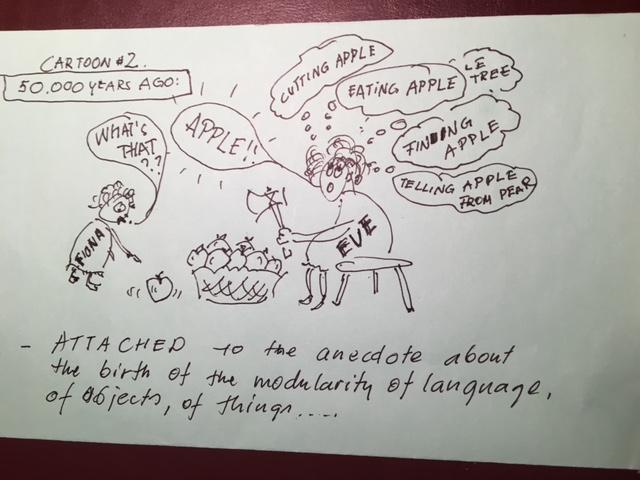
  Adam is rescued by Old Woman from the Homo Sapiens tribe and nursed to health by Eve the Beautiful. Adam saves the little girl from the lethal attack of a saber-tooth tiger. This little girl, Eve’s 5-year-old sister, Adam and Eve are creating a shared communication system that (my hypothesis) is growing into Language, Self, and Reality. ( “You called it apple”- it was the first hypothetical sentence understood by these 3 people, it contained: “you called” – the agent, the person, “it”- the thing-perception, sensory firing, a  piece of the old behavioral code, with its name:  “apple”.)

   To continue this thought experiment, we moved a generation forward. The three people who started to use agents and simple objects in communication were bonded by a prototype of a social unit: the shared magic of childhood, love, and of desperate will to communicate. In about 15 years this group grew and their shared vocabulary rapidly expanded. Summers were warmer and there were a lot of fish in the river and berries in the forest and babies in the tribe. Adam and Eve had 3 children Mel 8, Fiona 6 and Sophie 4. The” little girl” is now 16 years old and has the name.

                                           ***

‘My name is Danka, but people call me Dancer. I love to dance. I play the flute, the horn, and drums. I made my instruments with my Uncle Adam’s help and I taught myself to play. 

I go fishing and pick fruit with others, but I am busier and busier with my music.  When I sing and dance the world around me changes. 

My family and others from the tribe come to listen to my stories and to dance with me. Mel, my 8-year-old nephew can play the drums well, but only I can play flute and horn well.

 The stories come to me, I do not know where from, they just come.

Sometimes they come from my dreams and memories of winter and fighting with tigers, and sometimes from flowers and jumping fish. I am teaching kids how to sing and dance and about flowers and animals and seasons.

   Lake Cave Summer Feast is coming up. 

Each year before the midsummer Full Moon young people go to the cave. It is a difficult trip, it takes three days of hiking through treacherous mountains and into the cave. You need to be brave and curious and strong to get there. Last year was my first year, but this year I will lead my people. 

Eve tells me:

“Danka, to make a strong drink we need special berries from the Western  Forest. Take my kids to help you, but be careful, other people live in the West.”

I run like a wind, light and happy and strong.”

 “Who needs the berries

   We need the berries

We find the berries 

    In jungle!

We pick the berries

Magical berries

The sweetest berries 

That dangle!.”

***

Eve’s three kids follow bellowed Auntie, trying to catch up with her, laughing and tumbling. Mel, Fiona, and little Sophia who is just 4 years old.

Danka runs and sings her song “who need the berries”. On the “jungle” and “dangle” she jumps very high, landing on both feet into a deep squat.

Other kids are tripping, trying to mimic her.

Then she skips, then she twirls, still running, three kids after her in the narrow path among giant acacias and prickly raspberry bushes.

Mel is the drummer. He beats the rhythm with his left hand hitting his leather bag. This is not easy because, on his right shoulder, he carries his weapon, a 5 feet long spear. He is also an expert thrower, ready to protect the girls against any danger.

“ But,” he laughs,” all the animals will run away scared from Danka’s singing and jumping”

As soon as he finished his thought he noticed a movement of a shadow among the trees.

Then there is a strange, terrible roar. He has never heard anything like that before.

“WWRAOOOW”

He is ready to kill it.

“ As soon as I see his chest- the beast is dead- whatever it is”- Mel killed a bear and hyena before.

He sees the huge hairy head in the bushes.

“It is mine”, his right arm takes back, and the hips and torso recoil like an enormous spring.

“Wait, wait”- whispers Danka-and he stops at the last moment.

The “beast” jumps out, under the big head there are blond curls and a boy’s laughing face with the funniest brown dots all over it, but most on the nose. 

“What’s your name?!” Danka yells.

But he runs away and he is fast, waving with his “beast” head.

Danka laughs “ Mel, make sure you do not kill silly boys, it was a close call”

She likes this boy. A trickster. She remembers him from the last year, in the cave, he was really small and skinny then. But she remembers the laughter, the freckles, and the funny shadows he made with his hands across the fire in the cave.

 “I hope to see him again next week- if he is not killed by somebody by mistake”- she sighs and smiles.

Next week she will lead her tribe’s youth to Cave Lake. They will eat mushrooms and drink magic foods and potions and then they will dance.

She will dance with them, but her dance is different.

Eve worries about her little sister. 

“ Danka, you’re too much, you just don’t care, you just sing and dance, how can I protect you? Elders are not happy.  Big Man’s older son wants you to be his woman. It is an honor to our family”.

Danka doesn’t care for Big Heavy Max.

Eve sighs and hugs her sister. “Be careful, but when you find the boy you like, go for him”

Danka laughs “ I will, sis”, she twirls with her, then runs away singing and skipping: “I will, Oo-oh, I will, Oo-oh , how I reeeeally will!”

Old women and Eve send them off. About two dozen of young people, boys and girls run away from the village. They run towards the Western Forest and The Mountain. They carry food and drink and wood for fire and they run. They run for hours and hours, then they sleep for a few hours and they run again. Exhausted, and excited thy see The Mountain. And they find the small mountain lake and the cave on the shore. Danka leads her people into the sacred chamber. There are other young people from other villages. 

They are exhausted after a long run but they start a fire and then the drums call them to dance. Their dance is powerful, it sounds like a jungle, like a waterfall and thunder. It sounds like a buffalo stampede or the lion’s kill.

The drinks and food are served by girls, and boys do more dancing and showing off their skills, jumping over fire, and wrestling.

 Soon nobody remembers that they are tired and the dance, shouting and competition becomes more fierce.

 Then Danka jumps out, climbs the elevated flat stone, and blows her horn.

She sees the boy with freckles. And the boy sees her.

She wails and she sings. They understand some but not all words. 

But it is so different, so beautiful. They never heard anything like this: she sings the story.  She shows it, and dances and sings it. They know it, they see it. It is about the buffalo hunt. But also about one hunter- it’s a boy, or is it a buffalo? And he is pierced by the spear, and he falls. He is killed. 

The woman, yes, they see the woman who loved him, she runs and embraces the dead man. 

They scream and then stop and there is silence. The woman, The Dancer, shows how “she lifts the dead body”, and the bloody head mask stays on the ground.

They hold their breath, stunned.

She plays the flute: how beautiful the boy is now and how she loves him.

And then she carries his bloody body and begs and cries.

Wow, she is talking to Sun and Moon, she begs Them- “bring him back for me”.

And they see; that death is final and the only way to be together with her love is..

Is to die. She falls. There is silence. And then… she wakes up, she rubs her eyes- was all this but a dream??

The boy with freckles  runs to her and shakes her,  he wants to tell her: ”I understood, it was me, and it was not!”

Will she understand? He knows what to do.

Andy, ( he has a name now) takes her to his secret place in the cave.

He makes fire- he shows the same story with his hands and shadows on the cave’s wall. He takes her hands in his hands and makes her hands show the boy with a big beast head.

She understands! He says “AAN- DY” She repeats, laughs, and points to him “Andy”. Then he makes shadows of young women.  “She dances”. He looks at her and she says: “DAN-KA”, he repeats: “Danka”.

Their hands do not part, they stay together. They slowly quit wrestling and showing shadows, but start showing young bodies what they want. 

 After they made love, hands still together, they fall asleep, and the campfire’s red ashes glow slowly dying away.

Andy wakes up and a tiny ray of sun lits the stone wall where they played with shadows. Was it a dream? No. He sees a beautiful woman happily sleeping next to him. He gently frees himself from her embrace, gets up, and stretches.

Then he brings the paint they used to make hands prints-thousands of handprints, generations after generations- time signatures, nothing more.

In his head, he still has Danka’s story. In his disheveled, half-woken head.  He shakes his blond curls, curses quietly, and starts painting. 

The world disappears and the pictures come alive on the stone wall.

It is hours later when he looks behind his shoulders.

She is awake, sitting, looking at him and at the paintings, smiling.

She starts to sway into slow, dance-like moves. She sings sweetly and quietly. 

“Andy, Danka, Aaaandy,

Playing by the fire, 

We live and love and liiii-ve,

And then we die.

                                   ***

The real language i.e. the communication between people as a sine qua non for the experience. Shared (?”selfed”?) narrative, music, and visual art as the simple beginning of our reality.

What is an Agent or SELF? All words have human origins. It means that at some point in time, there was a social agreement (usually unconscious) between some humans about a word and its meaning. Because of these social and pragmatic origins, over time these agreements shifted and shifted. I expect that about the word and meaning of say “an apple,” there was no need for much shifting, but such concepts like self or consciousness or soul or ego the agreements shift and shift and for every discussion, it is very wise to renew the such agreement. 

How about attaching “participants, selves or agents” ( “self” as the common language equivalent of “I” and “you” and “he/she”,  while using “agent” to denote “action of an observer”) to the concept of experience? 

Self and experience. 

Self experiences an experience. To have experience is to have self. No self, no experience. Simple and elegant. Again, it harks to the origins: we use language for conversations. That’s what makes an experience. Each conversation has agents (selves), content, and context. But context can only be described by additional conversations. How about the events that look like experiences? Pre-linguistic music, images, emotions, dreams, animal behaviors? Remember the last Neanderthal from my story? He was hungry, dying, and grieving the death of his son. But, by the will of the omniscient author, he had no language yet, then no self, no experiences. (of course- the author and readers- did experience that). He was using his sophisticated instinctual system to survive. Later on, with the magic of love, childhood, and translation, he, the Beautiful and Little Girl acquired the socially shared first word- “apple’ with its meaning of red round fruit (the first thing!). So, later on, he could try to explain his past, using his budding language and self to describe past experiences. It is a dramatic fictional illustration of a hypothetical event. But we live with hybrid minds. Your anger is a mixture of primordial, instinctual sensations and all language/self-saturated memories and concepts. Also: Your awe, love, headache, and friendship. Any difference between conversation and experience? Not much: more emphasis on “from you to me” versus “me with me”- both are social and “selfed”- i.e. language-loaded.

This agreement would also help with understanding, among other mysteries of the universe, our hybrid mind. 

The old part makes almost all nervous system, similar to animals, octopuses, and all. Peripheral nerves, autonomic nerves, whole brain with all myriads of codes, and algorithms. This old mind led us to get more and more complicated through the perils and challenges of evolution, it contains all mechanisms to survive, to outwit others, all instincts and gut feelings, altruism and competition, and anger and love.

It creates a sophisticated world, with emotions and feelings but this world belongs only to this organism. It is not shared and it doesn’t have things. It is extremely difficult to imagine such a being. All feelings and drives but nobody to feel and be driven. All fear, trembling but without anybody to fear. 

And then Homo Sapiens invented language. I described possible scenarios. Most likely I am wrong, but it helps with imagining the process. It started with sharing simple sentences like “I called it apple”

Strange, it had an agent, “self”
But no emotions, no value. The “stone” or “buffalo” is not good or bad. Revolutionary, it had things. The incredible advantage of things over the old system ”behaviors” is that they can be easily controlled! They practically “ask” to be controlled. The “self” controlling “a thing”: the consciousness is born.

The new ( maybe 50.000 years old?) system propelled Homo Sapiens to where we are now. The shared material world was controlled. Greed was born and it challenged more and more evolutionary-developed altruism. This is the core and deep origin of our environmental and social disasters. 

It also points toward the only way we can reverse this.

Shared Reality

Our environmental and social crisis has many unexpected repercussions and consequences, not all of them negative. As we are running out of the Earth’s resources, it made us think about and research nonmaterialistic societies, the origins of altruism, and human nature. Our collective unconsciousness, as whole humanity assumed more of the undertone; “what’s wrong with us?” And because the niche crisis obviously plays itself in the broad dimensions of time and space, these questions force us to be more aware of our deep past and (unfortunately) not-so-distant future.

The new data from neuroscience, prehistory, and linguistics allowed us to rethink human origins.

The discovery is simple and (like the notion that we come from monkeys) startling. Our reality is created by the human mind. Without the human mind, there is no reality. While the construction of this reality started recently, about 50,000 years ago by our human hybrid mind, it is based on our brain’s ancient algorithms and perception systems millions of years old. 

Since this new reality’s construction started, in the Upper Paleolithic period, every infant repeats this feat and builds reality simultaneously with building language, and selfhood in the first year of life. Every animal has its own world, only one, but we have two- an ancient, instinctual world of algorithms and the new one, shared with the rest of humans, symbolic, linguistic, attached to consciousness. As I will explain later, it started from sharing and naming simple things- like the baby does- but it is the only reality we know! And the only reality there is. ( “is”, the concept of existence, is the intrinsic part of this new system, and is related to  the concept of “self”)

What does it mean for the everyday person? How do these instinctual and new systems work together in our brains? The ancient, instinctual system works all the time-breathing, feelings, and moods- but when we talk to others, write, and use the language, this new system seamlessly piggybacks on the old one.

The things are real, the stone when kicked- hurts.  But: as everything is invented by the nervous system of our ancestors, so all kinds of extraterrestrials and supernaturals are also invented. And all cosmos to add. And everything that exists. Existence as a concept is probably a very recent invention. 

But, how about evolution. This new thing couldn’t have sprouted out of our brain suddenly, out of blue. 

 That’s right, it couldn’t. This is the hypothesis explaining the possible origins and the mechanism of the generation of this strange hybrid system. 

This is the new sequence of events:

 Some of them will appear in boldface, denoting my hypothetical thinking, the rest is well known. I do not need to defend my hypotheses, it will be written soon in detail by some super-professors from MIT or Oxford. ( I am going to be like Alfred Russell Wallace of shared reality).

8 million years ago: split from bonobos: both branches “worked” on the social niche, possibly our ancestors benefited from some minor mutation making it easier to communicate by sound.

Bonobos stayed with social communications via grooming, pheromones, and sex. Homo was improving a variety of sound production and/or discerning. It might have forced parietal hearing and memory centers to grow, made brains even bigger and childhood even longer. The sound system was perfect for prelinguistic algorithms improving cooperation, band organization, and defense. We can imagine that these improved signs and sound utterances are short outwardly but in the brain, they were part of algorithms growing longer and clumsier, part of million years of building, and very difficult to teach, especially without the concept of self.

4 million years ago: another split- “Robustus” branches worked more on using the big brains to defend themself against changes in the environment, mostly glaciation periods. They culminated in producing the Neardenthal, extremely strong, practical, “street-smart”. The “Gracilis “ branches continued with prosocial communications with homo Erectus sporting some evidence of the concept of the unknown, awe, burials, curiosity, and altruism. The benefits were slowly increasing but liabilities and dangers were enormous. Without the concept of self and of names of objects, the algorithms can do only so much in the material world.

Still, some of them managed to escape the climate deterioration- “first diffusion” 1, 7 million years ago. 

500 000 years ago, the last split into “Robustus”- Neanderthal and “Gracilis” -homo sapiens. The sapiens were eusocial, emotional, and emphatic, but still prelinguistic.

( I realize, that for many it will be impossible to imagine such a sophisticated and mature culture without symbolic language).

This gave us, our ancestors, some advantage over other groups but changes in climate eventually killed everybody except a few thousand sapiens remaining, somehow overlapping (Southern Europe or North Africa) with the dying remnants of Neanderthals. They kept improving proto-language, cooperation, altruism, and friendship, but the progression of the material culture was very slow.

My hypothesis suggests that the advances of social intelligence, with big brains without selfhood and language reached its limits– like many of the other intelligent and social species. At least 26 branches of hominids died and the Sapiens population was reduced to several thousand. The formidable social skills couldn’t protect against their environment, especially considering periodical glaciations and the eruptions of the mega-volcanoes during the last 100 000 years. 

50,000 or 40,000 years ago: This small group of brightest, most altruistic, and eloquent homo sapiens survived, they are our ancestors. I imagine a combination of three major factors and a lot of luck. 

  1. Close-knit family, they are on the move,(escaping cold or drought or other animals) trying to survive, and a lot of talking.
  2. Extended childhood, toddlers practicing talking, adults listening. 
  3. Possible elements of translation, desperate contact with other groups or Neanderthals with a different language, and utilization of a child’s learning process.

This is the imagined sequence of events: Proto language communication with sound being a part of a complex algorithm is understood by a child or foreigner as the name of the simple thing. Repeated back as such it creates a circle of people sharing a reality. The name and its meaning are attached to the person who used it. 

( the woman says: “ apples need to be picked up”,  the child cries pointing: “apples, apples”, and a foreigner says: “you called it apples?” and the woman repeats: ”yes, apples”)

Enormous social advantages are immediate. 

My hypothesis is that symbolic language, shared reality, selfhood and consciousness are the same thing, started together, as recently as 50,000 years ago, and are responsible for our survival and success.

50000 to 10000 years ago: The event described above ushered us into the next 40,000 years of the “Golden Age”.

The climate was excellent and shared reality and linguistic skills spread with trade, social life, art, and religion. It was the world before the Big Flood.

It took many generations for the concepts of ownership have become connected to power and pleasure. Humans were non-materialistic, so inequality was different than we can imagine. It could be appearance, being “close to higher powers”, personal skills, the rhetorical skills.  The “power”, still without material wealth, could be more fluid, societies changed from season to season. Huge monuments and mounds were built and destroyed without hierarchy, bureaucracy, and much of inequality. New archeological discoveries in Turkey, Stonehenge, and Meso-America suggest that.

10.000 years ago to the present. Domestication of people, plants, and animals. The “primordial sin’- materialism, eventually caught up with us. Shared reality allowed for agriculture, technology, and inequality. A thin layer of greed spread over our bran new world of things, relationships and gods. Empires and Religions rose and fell until the circle seems to be closing up and we are facing… each other again.

This timetable, based on the development of a hybrid brain changes the evolutionary view of human nature.

Homo sapiens emerged with an almost suicidal drive towards sociality, empathy, altruism, and emotionality. We used primates’ big brains, and rich sensory worlds fueling curiosity, especially the curiosity of others. Then we “bet” on sound-mediated communication, which turned out to be the “winner” bringing us off the brink of extinction.

The sound-mediated communication culminated in the invention of the language-selfhood-shared reality complex. 

This new toy combined with the relatively good climate gave us the abundance of the “Golden Age” with gods, art, and technology. Humans flourished spreading all over the planet.

And then, just recently,10, 000 years ago, let me repeat it: a thin slimy layer of greed appeared. 

How, why not earlier? It seems that the domestication process and concentration of the huge amount of people created the all-pervading illusion of happiness based on ownership.

Materialism, then capitalism and now we have to tame it or die. 

But, evil is not in our nature, we know that the happiness and satisfaction it gives are not real. Can we teach the new generation to get high on experiences?

What is a hybrid mind and where does it come from (Last Neanderthal)

What is a hybrid mind and where does it come from

We, humans, go through our lives using two completely different mental systems.​​ One is ancient, inherited from our animal ancestors, “algorithmic”, always active ( I will talk about it shortly), and the other system- which is very, very separate and new, just about 50,000 thousand years old.

To illustrate this shocking concept I will use a metaphor and a parable.

If you ask what is a hybrid car, the answer is very simple: it uses two engines, sometimes it is electric and sometimes an old-fashioned combustion engine.

  Many scientists think that a similar metaphor can be useful to understand our human mind.

It would be appropriate to leave this to science, but in the 21st century, the subject of human nature is very important for our survival as a species.

As we desperately try to avert the doom and gloom of the environmental disaster, this metaphor can unexpectedly bring a glimmer of hope, the way to work, and chances of survival. ( “Rome conference or die” talks a lot about our niche crisis).

Simple animals have brains full of evolutionary beneficial algorithms, like codes, and instructions of “if so it is good to do this”, but “if that, it is better to do something else”.

These algorithms are different from computer codes invented by a bunch of geeks- they were selected over literally billions of years by evolutionary mechanisms.

They include everything that we feel is right, good, and real.

They aim to help us to 1. Survive

                                2. Multiply

                                 3. Protect our genes

They aim at keeping the species’ niches as strong as possible.

So, these instructions are really, really smart.

Our brains are full of them, it is why our brains are so huge.  They direct all automatic functions, breathing, digesting, seeing, fighting covid, fearing covid, disliking covid vaccines, balancing these two, and many other instinctual functions.

But when you meet a friend, suddenly you are piggybacking on “great to see her” or “who is she?” a completely new system. You chat. The language. These ancient algorithms would not do.

Why? They are big and clumsy. And the more complex they are and the more branches these instructions branch themselves into, the clumsier they become. But the crucial difference between these two systems (Merlin Donald in ” A mind so rare“calls ours the first hybrid brain) is that: The algorithms create the world for the organism that is its own, it can not be shared- it is why animals learn poorly- and teach poorly. My hypothesis suggests that like animals, hominids with all their intelligence and culture did not have symbolic language. They were ready for it though.

So, they did not have “I” or” you” or “self”, they did not have” things” in their communications, no creativity, no imagination, no mathematics. It is actually extremely difficult for us to imagine and describe with words living in that pre-linguistic world, animal algorithms world.

About a hundred years ago Jacob von Uexkull ( A Foray into the Worlds of Animals and Humans:1934), imagined and described the life of a tick, he called its world UMWELT.- perception and action, perception and action, etc, etc. Then in 1974, Thomas Nagel wrote: “What it is like to be a bat” saying basically-” we do not know, we need new concepts or theories”.

Thus a Parable: A dying Neanderthal is rescued by some women from the Sapiens band.

The time is about 50,000 years ago. The Neandertals were decimated by climate and by technologically advanced Sapiens.  The content of our DNA suggests that very few Sapiens (10 thousand or less) and no other hominids survived this period after Mount Tuba’s and Campi Flegrei’s eruptions.

But soon (after a few thousand years ) these survivors flourish, populating Africa, Europe, the Fertile Crescent, and then the rest of the globe.

What happened?

Pre-linguistic Sapiens -maybe helped by Neanderthals, maybe by extended childhood- (see below)- were inventing symbolic language, selfhood, and shared reality.

The Last Neanderthal

Hunger. Hunger and freezing.

The clouds are lower, bad, it is going to be more snow.

It’s getting dark but need to get to the bottom of the mountain, there can be a cave, or at least a rock overhanging. Can make a camp there. A camp?

What kind of camp? There is nobody here.

Again cold black despair. Damn, there was the son, a wonderful, strong boy.

Is gone, gone, gone, did not withstand the cold.

Hungry froze, died.

Burial in despair, crying digging the bloody snow. It was two or three days ago.

Earlier (the Moon was full), it was the Woman.

She was not eating so the son could have her food.

She died, frozen, still wonderful, incredible.

Before she died, she showed where to go. She said: “ go, go, need to follow the Sun”

But there could be Others. No strength, no people to fight, they will kill.”

She said again and again:

No worry, go, go, following the Sun, no worry, no fear about the Others, need to follow the Sun

She died, need to go, go further.

Tiredness, hunger, freezing.

The wind goes to the bones, everything hurts.

Step after step, step after step.

Rest… No.

No more food? Chewing my sheepskin, my leather belt, ate some rotten crumbs at the bottom of the sack.

Finished , and nothing was left. Only step after step, following the direction where there was the Sun.

Now it is getting dark, getting even colder, the wind.

Still walking… still walking?

The Woman and the Son are already here?

Darker and darker.

A tiny light.

Fire? Impossible.

There is a light, red light.

Fire. No, can not be, there was no storm or lighting since the last New Moon.

But there is, there is, something flickering like a fire. Our people? There are no our people there. Others!

Need to get there, fire means warmth.

Remember warm?

No, no.

They will kill, no strength to fight, barely walking.

What to do? Fear and hunger. The Woman says “go, go.

So, step after step, step after step, whatever…

 Maybe, possible to approach stealthily, steal food? Is this possible?

Fear, terrible fear.

Fire.

 Shadows of Others, now visible. Women?? A child??

Suddenly, Wrrump!

Falling in the ditch, thud. Terrible pain, in the leg.

Nothing.

Now warm, really warm. Difficult to breathe, cough, cough it out. Spit out the phlegm, better.

Warm.

Run!, need to run! No. The body doesn’t move, and this bad pain in the leg.

So, crawling, maybe? The cave. The Other. An old woman, showing something.

Don’t run”? Yes, that’s it “ Don’t run

Aha. “Lie down” and Leg, no good”.

Eat?” she gestures.

Cough, fever, everything hurts. “Drink, drink”.

She repeats the gesture ” Drink”,

And: “Yes, wait

Warm drinking! warm and good, salty?-Throat burning.

More”.

That’s it, thanks,

WHY?

What?

Sleep.

The night feels hot, the pain in the leg, can’t run. The Moon is full! so many days?

How come? Sleep.

The Others scream. What?

A young Other with the spear! Fear. He wants to kill. The old woman screams the child cries, and an old Other came, screams. Pushing young killer away.  An old woman gestures, “no fear, no worry, you are mine”.

Thanks.

More days.

The child, a little girl, laughs, and brings “sweet and tart” food. Very good.

Another woman. Beautiful. She gives warm meat, ah, so good, so beautiful, so good.

Walking slowly, with pain, but better.

There is nobody around, only Little Girl.

Hearing something terrible, oh, so well known, terrible killer on the four legs. Sensing it, smelling, feeling its ugly breath. Even if it tries to crawl quietly. The little girl. It is ready to pounce on her.

The little girl has to be saved, needs to live. A spear is here, pain, pain. Only slim chance, all my strength, NOW.

A huge shadow hit in the air. Now this sharp stone and break its eyes, its skull, HIT, HIT,

Its claws tear stomach, ouch, and it is dead. The little girl screaming, runs to me, blood everywhere.

The others running here, the terrible four-legged lying pierced with a spear, skull broken.

Old woman, the Beautiful, crying, screaming. Thanking??

Black., nothing…

The Moon is New, how many days??

The stomach wound is still terrible, oozing. Sleep.

The little girl gives “sweet and tart’. She laughs, and dances.

The Beautiful teaches Little Girl. It is good.

The Little Girl shows, pointing with her little finger: “this?”

The Beautiful responds “ apple”.

“Hmm?”

She turns and looks at me: “Call it apple

APPLE????

The Beautiful laughs, falling in love: “yes, apple”.

The end of the parable.

We met our “last Neanderthal”, he lives on instincts, the ancient and newer algorithms. The new science, “archaeogenetics” tells us that Neanderthals split from homo ancestry about 500,000 years ago, just before symbolic language was developed. But in the last few lines of the parable, he discovers “me” and “you” and “apple” (a thing), and very soon, I am sure he will try to have as many apples as possible to impress The Beautiful (and the Old Woman).

It could have happened for the first time with the help of our Hero and the Beautiful, but it occurs in every human infant who learns shared reality, names, the language.

Every human baby is born with inherited instincts, similar to these of the primitive hominid.

But she is surrounded, she is “bathed” in human language, names, things, people, and actions.

As our Hero tries to understand the budding language of Sapiens, every human infant begins to understand some words (around 3 to 6 months of age) then the objects and names merge into Piaget’s “object permanence” (around 9 months), and then she starts to point and practice first words.

Back to the parable:  Where the “apple” came from? It was still like a miracle or an extremely rare event. Unlikely modern infants, the Little Girl was not surrounded by human speech and names of objects. Instead, she was exposed to useful responses and skills she had to practice and imitate. The Beautiful could have used the word ”apple” before, as a part of an instinctual action-related expression, like “going to pick up apples”. Teaching the child was pretty normal, but teaching our hero and getting his understanding- was an incredible breakthrough. In the end, these three ancient people, the Neanderthal, Beautiful; and Little Girl shared the piece of the algorithm, the concept, the name, the thing- an apple.

It was the magic of translation- the magic of naming, and we could imagine that new words and concepts of self “I” and “You “ and other simple “things” followed and streamed like an avalanche.

The language with objects and people opened so far forbidden domains of ownership and calculating. And the hominids were (at last) ready for this critical jump, they were not only ultra-social but also “ultra” engaged with material culture (Colin Renfrew, Prehistory). This was the beginning of the world we now call “reality”. It was a different world than ticks or bats… and hominids’. It was a uniquely human reality shared in this social circle and soon shared by all humans.

When in 1769 Cook’s expedition encountered Haush people on Tierra Fuego they could use gestures, “play charades” and understand each other ( see “The Language Game” by Christiansen and Chater). The authors misinterpret the charades for “creating the sign language”. But no, it could work only because both groups had symbolic language! It was just a process of translation. Both groups had language, the “things”, the “I “and “you” concepts invented by their ancestors;(maybe the last Neanderthal, Little Girl, and Beautiful.)

This concept of a brand new type of communication challenges the belief deep-seated in our collective unconsciousness, an image of a human being as a smarter animal. No! This new system was non-continuous, ( it is what good old Noam Chomsky and Eric Lenneberg were saying) When you open the skull you have the same brain as an animal but bigger. When scientists look into its function, again it is the same but smarter, more complex, with more memory, better thinking, etc.

The consequences of this unspoken myth, this illusion are profound. It implies that we can’t change, can’t be blamed, and can’t be responsible. The forces that created this mess are beyond us, whether divine or “in our genes.” Or most likely: “whatever”. Even religious people who do not believe in the evolution of animals into humans see the human world as essentially the same as animals but more complex. But it is an illusion, these two systems are completely different semiotically, and animal code means benefits to animal’s niche. Symbolic, shared reality has meaning for the niche of the species, Homo Sapiens. We are children of social, tribal, shared reality not slaves of animalistic survival.

So, embrace the new paradigm, the hybrid mind: the ancient and newer algorithms are working constantly, the instinctual world separated for each of us, but when we talk, write, and think creatively when we act consciously, we piggyback new reality, a new World built in the infancy shared by every human, and by humans only.

This strange hybrid system makes us ultimately interdependent- a shared reality.

And very vulnerable too: we name things and ideas according to the way we live.

Origins of materialism (reading A.Hinton’s Understanding context)

Reading Andrew Hinton’s Understanding Context. ( version 7.11.21)

  1. Introduction: animals’ language, human language, and computer language: three languages, same principles. 
  2. Part I: A case against relativism and homo translensis. 
  3. Part II: The origin of things
  4. Conclusions: three languages linked to three events.

Introduction:

  Eve is a very, very smart 5 year old. She sits in front of the basket of apples, the knife in her hand. Her sister, Fiona, barely 18 months old, walking, talking, and asking questions, noticed that one apple fell from the basket. “What’s that?” she asks and points to the apple.

 Miraculously, Eve answers: “apple!”.

I will try to explain why this answer was really a miracle. 

 Now we have to add that they sit in front of a cave, the knife is made of stone, and it is all happened 50 thousand years ago. It means that in Eve’s brain there are many, many neural networks, useful for homo sapiens, that include different fruits. These algorithms help Eve “ find apples”, “tell apples from pears”, “chop apples for sauce”, “eating an apple” and so on. But in her brain- and this is a part of this essay’s hypothesis-there is no “apple” as an object. But, somehow, miraculously, breaking the algorithm, separating a piece of her reality, her environment, from its function, she answers “apple”! 

    This essay is about the nature of our surroundings. It might also, while discussing surroundings, give us some glimpses at our nature. 

    The surroundings of an animal are, from the point of view of this animal (sic!), determined by the activity and sophistication of its nervous system. From our, human, point of view, we can only muse: “What is it like to be a bat” and agree that we’ll never be sure. 

It doesn’t stop science from working on the nature of experience. Ecology, ethology, and semiotics are all about it. And philosophy- like phenomenology and natural philosophy.

    The animal’s senses and its brain create the animal’s world which Jacob von Uexkull called Umwelt. Again, depending on the point of view, the same thing, we can call a “habitat”, “niche”, “environment” or just “what’s outside”.

Depending on the point of view… or “context” ( we are going to abuse this term mercilessly). When scientists are talking about an animal’s surroundings some more shifts occur( I mean shifts in the conversation’s perspectives we usually do not notice because it is so ”normal” for us). In biology, like in modern physics, the results of investigations change with the actions of the observer, his or her attitude, purpose, method, and prevailing scientific paradigm. Think about the interpretation of prehistoric fossils or ancient artifacts. And using the term “context” emphasizes the fluidity of the thing or even its arbitrariness.

I have been working on people’s personal worldviews for the last 10 years. What is the worldview if not a point of view ( or context) from which we see the world? And what is understanding context if not transforming the implicit, unconscious, gut felt, and acted worldview into an explicit, spelled out, clarified set of rules and structures that help us navigate our life? 

When a postmodernist like Derrida or Foucault talks about their beloved context it becomes something very abstract, like a cloud of meanings surrounding a concept or a story.

“This does not suppose that the mark is valid outside its context, but on the contrary that there are only contexts without any center of absolute anchoring. This citationality, duplication, or duplicity, this iterability of the mark is not an accident or anomaly, but is that (normal/abnormal) without which a mark could no longer even have a so-called “normal” functioning”. (Jacques Derrida, Margins of Philosophy)

Yes, the philosophers and scientists tried to handle the question of context/surroundings (see above), but it was not until computer people explained this to us that we got some traction.  Computers help us to solve the problems of the real physical world. We need them for health, economy, research, communication, basically for everything we do. 

The computer people squeeze all our problems into the screen.  Then, they have to translate or shift the domain of the physical world into language and symbols, then translate these semantic elements into a digital world. Then, after they crunched the numbers they proceed to reverse the process back to the screen jargon, and voila, they are done. 

When computer guys (like Hinton) talk about context, this cloud of meaning, even if stuck inside a computer screen, becomes much more physical, more like a place or a map. This concreteness, physicality even if strange in the virtual world, feels natural for them. They are living there, working there, creating and designing the content and the contexts itself around it. They interchangeably use the terms for context like “environment” and for working with it – “architecture”. It is why Hinton uses Gibsonian ecology as the model for understanding context in this novel, rich and useful way. Following his lead in this essay, we will blend discussion on the computer environment with the physical human environment and cultural-semantic environment.

Part One: A case against relativism – introducing homo translensis and “domain hopping”.

 This introduction might suggest that the nature of our surroundings- which is nothing else than our reality, our solid, real Universe is not so solid. This talk about shifting domains, of the point of view, of the role of the observer in modifying reality; it all smells like relativism. And, how properly for our times when relativity rules. Gone are our basics, our standards, and our rocks.  God is dead (Nietsche ), the President lies (everybody knows)  the corporations cheat (they mean to do it) and the media is full of fake news.  But humans know better. Relativism doesn’t help, doesn’t solve any conflict, it is the queen of the stalemate.

The trick of relativism failed us with religious wars, with religion versus science dilemma, even with biology vs humanities squabble. Where did Cartesian duality take philosophy? Well, pretty close to its demise.

 The insight for the better way comes to me from Andrew Hinton’s Understanding Context. Hinton starts with a story- him, a computer geek, catching a plane. He leads the reader through a number of overlying contexts: his iPhone, with his calendar and schedule, his office computer, a colleague’s laptop, the airport’s computers-security, and the cashier’s – the main object of interest hops from screen to screen- his flight. He switches domains and environments- digital, physical, and linguistic – he walks (or runs) through the airport, the shuttle, and (at last) the plane. He has to understand and hop through all these meanings -symbols, icons, messages from outside and inside. Unlike Derrida’s contexts- his are very, very real.  I realized while reading his book that coping, conquering, and understanding different contexts and environments sits deep in human nature. Switching domains- actually holding them simultaneously in the mind for a moment- this what understanding is- it is like translating from language to language and comprehending- using them both. I also realized that these processes- these “domain hopping”- are everywhere.

Cartoon # 1

As a senior pediatrician, I talk to every new employee, a doctor, a nurse, or a front desk person. I always draw for them and explain these symbols: “The circle. This means empathy- we are one-we are equal- we embrace them with real or symbolic arms. The second is a square: we translate their square problems into something we can help him with, the third is “plugin” or action- or complete- do what you need to do and document it so you can have a clear mind ready for the next one”. 

Both, understanding and following these instructions – require constant shifting contexts or domains. The other examples are meditation and prayer- you shift between the transcendent and your mind.

So, the truth is there, real and important. It is not the truth that is relative, it is the context, the view, the way of looking, that shifts. I mentioned “domain hopping” and I will return to it, but I think it is how our curiosity and obsession with figuring things out, works. We are ” homo translensis”- we know one thing, then we stick the same thing in different domains or media, or modes. It is like translating from one language to another: for a precious moment, we have to hold both things or thoughts or truths in our minds. This is understanding and it is everywhere.

Our computerized world just made it so obvious.  

So, was it always like that?

Part II.  A hypothesis. “The origin of things”.

     No, it was not. In his recent book, Peter Godfrey-Smith explains how the mind works for very simple and very ancient animals- mollusks, cephalopods, or fish. Their simple brains connect perception with action and maybe “presence” in one experience of living. From “if”- perception, to “then”- action, like a procedure code in your desktop. 

It is extremely hard to imagine a world without things. In my hypothesis – this was the world until about 50,000 years ago. The forests were full of birds, monkeys, and hominids – full of life, intelligence, and communications, but none of these creatures had discrete objects in their worlds.

What was going on 50.000 years ago? 

This we know:

Like dinosaurs 260 million years ago, about the last 10 million years witnessed a phenomenal expansion of great apes. 

 These monkeys invented complexity unheard of before. They were, as great E.O Wilson tells us,  hypersocial or eusocial, rivaling only a few other genera like ants, bees, termites, etc. But unlike others they had huge brains, hands to manipulate objects, and communications based on vision and sound. Many bands and tribes evolved and were selected for cooperation, and altruism. They were spreading to more and more diverse habitats. They invented axes, spears, and fire. They developed cultures with burials, art, stories, and gods. And they were avid learners. We know of 27 major branches of hominids.

They all died out, except for one small group or tribe- 10,000 individuals or less- us.

 This part is pretty much accepted and non-controversial. 

But from now on- hold on to your seat.

Their communication or proto-language was based on procedure code. Just like very primitive animals’ communication.

The animal brain as we understand it contains only algorithms coding for evolutionary beneficial behaviors (traits), probably nothing more. Anything else would be energetically prohibited- impossible. And the more complex these neural networks are, the more “costly” they are and benefits have to be more striking for the new trait to survive and expand. It is the pressure to develop the brain versus the pressure to evolve muscles or fur. Example: the process of domestication of wolves to dogs-  dogs can “ handle” and “understand” humans better than wolves but they “pay” with weaker muscles and smaller teeth.

Over the eons of evolution, big brains become very costly- and still are.

The communication algorithms allow for social and cultural complexity-equivalent of our knowledge-were becoming more and more elaborate- say like bee dance or skill to become alpha male, or telling a story and false story and magic story. It is difficult to imagine that, but half of the algorithm, like in procedure code, has no sense. The algorithms have branches, maybe thousands of them but no modularity. So the learning slowed down, the evolutionary pressure and competition between muscle and intelligence became more fierce. !00 thousand years ago it might appear that robust, stronger hominids ( h. Neanderthalensis )prevail over “gracile” (sapiens). Over the last 6 million years the increase in complexity slowed down. Stone axes were still stone axes after millions of years!

Note: Everybody agrees with these simple biological facts… when we talk about bacteria, spiders, even fish. When we start to talk about more complex animals, magically they become more like us, especially pets or animals one spent all one’s life investigating ( chimpanzees, octopuses). Their behavior might look like ours, but their minds and learning work more like neural nets of modern AI than ours hybrid brains.

So, it is like the story of “primordial soup” to explain the creation of life with the abundance of all rare elements, warmth, sun, lightning storm, oxygen, and nucleotides swimming around and hoping for a stroke of luck…

Similarly, our ancestors, with super socially intelligent people, migrating under the pressure of stronger hominids had great language, and great parenting, and Eve and Fiona had a moment of genius.  Eve was in the “magic years” period, Fiona in the “joint attention” pointing phase, and humanity was in the “dream world” phase.

Thus, Eve, miraculously, shares the piece of the procedure code her sister pointed to. Preposterous! The pieces of codes have no meaning- well, they did not until now- from now on her and her sister share the concept and a piece of a new reality- an apple. This single event has to be combined with creating or just naming each other’s self (thanks for the close-knit family, talking constantly)- otherwise, it would have to be invented over and over-and this is impossible! The apple was Fiona’s and Eve’s first shared, independent from the procedure code, thing. I imagine that the next step was to share this with Mom and Dad.

     Animals do not do that, there are no objects in the Umwelten.*  With the object, like an apple, there is a cascade of benefits, there is no looking back. The things do not exist unless and until named. The name/thing duo can be easily shared with others, it has attributes, it has quantity. This brings abstract concepts floating around our apple. Most importantly with a thing, you can want it, own itand share it. Actually, the meaning of “apple” contains its origins. It is as if  Eve said, “I  call it apple”- pointing to the metaphoric and cultural nature of this thing. I imagine that for many, many generations the new world of things coexisted with an old world of procedure codes, of perception-action arc, where if is a primitive agent that does the action- then. Animals have in their brains plenty of procedure codes for actions, truly beneficial actions, but completely anonymous- benefiting the species which is- a concept- a nobody. The huge advantage of the you-me-object -attribute system was the gate for fast technological and social progress. And, to prove it, we survived.**

 Like in this essay: it is what we humans do: “hopping domains”. The existence of named objects enables shifting perspectives, it is like advancing from a two-dimensional world to three-dimensional space, when you get it, you’ll use it all the time.

Another Note: It is difficult to imagine life without things. It is, I guess, like all you know would be the type of knowing how to ride a bike, how to play piano, how to make out with other humans?

Part 3. Conclusions.

Look at these three parallel events. In each, the world of the procedure code breaks and develops into a different reality or domain or metaphor.

1.Rare or just a single event:

Ca 50,000 years ago, a small band of homo sapiens acquired modularity of language, the concept of objects which expanded to a shared reality.   All other brands and branches of hominids that did not get this died out.

 2. Very common:

 It happens to every baby 6  to 12 months old since event #1. Babies develop “object permanence”.  She now knows that the toy that is hidden will not disappear forever, it is still there!

Pre-linguistic communication shifts to language and shared reality. Now we can see that the term “acquiring object permanence” is an oxymoron- in our shared reality objects are permanent by definition, until then, in the infant’s world, there were no objects separated from functions.

3. Recently very common,

Computer programmers and object-oriented user experience people perform similar tricks. The anonymous, pre-linguistic concepts, tasks, and problems defined in the form of the procedure code are transformed and transferred into shared by users pseudo-reality or (nicer) computer reality.

   All three events describe the now-famous “domain hop”: from procedure language, shared object-oriented, user’s reality emerges. ( thank you, Fiona and Eve). The original event was so rare that it looks like a miracle. Then every human baby learned to repeat that. And recently humanity learned how to perform it, with computers, “on-demand”. 

Content creates context. The object creates an agent – self. Understanding, translating, domain shifting, domain hopping is at the core of our human nature. It is how we survived.                                    

                                                  * * *

                                              * * *

*  Wait, and how about Japanese monkeys who learned how to wash potatoes? It was not an object, it was socially sharing the behavior, an algorithm.  But without the object independent from function there is no breakthrough, another skill, that’s it. 

** This broad description of the hypothetical event skips linguistic jargon of “qualia” and “memes”, and skips evolutionary mechanism’s details of spreading of beneficial traits.

Tom Voychehovski

Invention of things

So many puzzles, one key.

Here are some examples of puzzles:

  1. The anthropic dilemma or fine-tuning. 
  2. What happened before the Big Bang? Or how Entropy 0 can change to non-0?
  3. Why did we not find any evidence of aliens?
  4. Where is the center of the Universe?
  5. Why are homo sapiens so much more complex than other animals?
  6. What was crucial in the human evolutionary leap?
  7. What was the evolutionary origin of human language?
  8. What was an evolutionary origin of materialism?
  9. What is the solution to our niche crisis?

The key: the event which occurred over a relatively short evolutionary time- probably several thousands of years, about 50,000 years ago in Africa or the Middle East. It involved one or at the most a couple of groups of ancient humans. 

     To continue the explanation or the description of the hypothesis- the key- we need to stop and insert an explanation. An explanation for the explanation? Yes, this sentence might need to be moved to the beginning of the essay, definitely can not be postponed. The explanation involves bootstrapping. ( A la Baron Munchausen) Explaining the working of the human brain with the human brain. Explaining the nature of reality using the language created by this reality. Explaining the complexity of the system using tools created within this system. It is why our explanation doesn’t explain what really happened, but how we continue to improve our explaining it. The best and the only thing we can do- is bootstrapping. It is obvious then that the nature of things reflects (or follows) the nature of our probing system. Mainly our brains but also other experimenting or probing machines. The results of probing depend and reflect the structure of the probe. 

       Another metaphor can be helpful: You look and you realize that the fur gloves you have worn for a long time are actually inside out. So, you flip it, put it on and it obviously works much better. The cold hand’s problem is solved. No repair, no surgery, no expense, just a fresh look- so simple, and the result is incredible.

     Now, back to the cavemen.  Well, the event I am going to describe carries similarities to several older events. We see these events as a cluster of extremely unlikely circumstances that occurred only once (an event can not be rarer than that). Like: Big Bang, creating solar/’planetary/earth system, creating life from no life systems, creating a nervous system to support nonrandom behavior, creating big brain social mammals in post dinosaurs niche. 

We also see our lives similarly- the nodes of unlike events and circumstances. I hypothesize that our brain creates in developing neural networks an important (nodal) but uncommon structure (few axons or dendrites) reflecting the structure of these outside- (niche) events. Or, if you reverse this concept, outside events reflect neural structures. ( the “glove hypothesis”- the glove corresponds to perceived reality, the brain is the hand inside the glove).

     Now, really back to cavemen. The unlikely cluster of events occurred circa 50,000 years ago. The horde which became our ancestors was migrating north under the pressure of bigger and stronger hominids. 

They had to outsmart them: by the level of cooperation and sophistication of communication. In migration, the children in the band were few and exceptionally precious. Many members took care of them, communication, talking back and forth was more intense, more social, and prolonged. Toddlers who started to talk were still being talked to and nolens volens listened to. Toddlers naturally: 1 ask questions, 2. ask for names of things. 

      Until then the communication had a lot of characteristics of animal communication.  When I read about the evolutionary origins of language, invariably linguists make it extremely complicated and jargon -saturated and missing evolutionary mechanisms. Communication is what the nervous system does, it was created to enable organisms to develop nonrandom behavior. So information from outside the system can benefit the system. This actually defines and creates “outside and inside”. The cells have their internal communication system, then when cells become “social” and create multicellular organisms- it opens new “outside”, and at last, when organisms become social- the concept of outside moves up to another level. The information which does not benefit the system- does not survive, the things it describes – do not exist. So the content of information is always the same: the descriptions of beneficial behaviors. You manage to remember it, you live, you manage to inherit it- your species niche expands. In archaic bacteria, it would be “move towards higher sugar concentration”, In bees- a dance directing other bees to flowers- in chimps- the details of organizing a rebellion against an alpha male. These descriptions might contain communications full of actions, places, objects, and animals but it is not language. They might contain stories, memories, emotions, and logical decisions but it is not language. Or, you may call it proto-language. Because of the crucial difference between that and human communication is really not linguistic. It’s ontological. These animals and early humans have the concept of reality described by Jacob Uexkull as Umwelt.  Their brains are full of beneficial behaviors. Nothing else. And beneficial behavior expands the species’ niche- usually but not always improving organisms’ survival and reproduction. It is impossible to manipulate this type of reality, the more complicated behaviors the more unwieldy it is to use them in different situations. The learning is painfully slow. Hominids hit the evolutionary wall, over the last 5 or 10 millions of years, they all died.

      Then, the miracle happened. The cluster of unlikely circumstances and events occurred. 

       The 15-month-old cave girl said: “daaaa’’ and pointed at the apple. ( She meant “ what is that, sis”?) It’s called “joined attention” . Her older sister answered: “an apple”. The older sister pulled the apple from the description of behavior- about how we find apples, which are good to eat, etc, etc. Then she stuck this apple into a brand new thing – reality. It was very small, beginning, just between the toddler and big sister, but they could manipulate it easier- “two apples, big apples, red apples” the endless uses of the THING. ( Notice that she mixed domains-or dimensions- the trick very often used with inventions, like a steam engine, gravity or double helix ) Paradoxically the reality which was starting to be socially shared opened the door for individuality. Budding modularity made recursive speech possible. In the Umwelt world, it was only me with my niche. 

      But now, or with a generation or two, with the invention of things, it was so easy, soon the whole family used more and more names, not as a part of the description of behaviors, but as building blocks of intergroup reality. Now the same story could be told in so many ways. How many fish do we need? Well, how many are coming for dinner?  You could talk about the quality of things and the quantity of things- the birth of abstraction and mathematics. And, after you talked about things- next big step- you could own them. And lack them.

     It probably took generations to populate the budding joint reality of the group with things. But modularity, later known as grammar, and recursiveness were the keys.

Now, an easy part, the puzzles.

  1. The anthropic dilemma or fine-tuning. It is true that many facts in the history of the cosmos, origins of Earth, and life on Earth are incredibly rare and improbable. The same can be said about evolutionary facts leading to modern humans. But if you examine the events leading to the creation of Saturn rings, or penguins, or squirrels, these are also incredibly rare and improbable. The measuring and exploring and assigning of probability occur within the same system. Chinese medicine does not see any brain- the probing and the result operate within the same system.

       2. What happened before Big Bang? Or how Entropy 0 can change to non-0?

Again, the time concept and Big Bang belong to the same system. The Universe began with Big Bang – they are all human-made concepts and if something was before we would not call it the beginning. Entropy occurs in time, and when there is time, there is non 0 Entropy. The time is defined by change, with change the order has to be imperfect -sooner or later.

       3. Why did we not find any evidence of aliens?

Aliens with gods and unicorns belong to human stories, as does the rest of the Universe. So, they do exist, inside our culture, like forest, fear, and Finland. And there is nothing outside, they are real inside this mind-boggling reality.

       4. Where is the center of the Universe?

The reality and the Universe were built during the evolutionary development of the nervous system. Every living organism has its center of reality inside the organism (well, how about ants or bees, do they share it??). Humans are an exception. They developed, starting about 50,000 years ago, shared reality. Their stories, which by and by become myths and then split into religions and science contained the notions of the center of the Universe, but ultimately these concepts and constructs are related to human intelligence. As long as we stay here on Earth, even if our science or religion points into a special part of heaven, I would assign the center to the person who points there, wouldn’t you?

       5. Why are homo sapiens so much more complex than other animals?

We invented things, language, and the Universe and it makes learning exponentially easier.

        6. What was crucial in the human evolutionary leap?

The invention of things and abstract thinking ca. 50,000 years ago.

        7. What was the evolutionary origin of human language?

Intragroup reality switch- from social and emotional sharing to language sharing to reality sharing to language modularity.

       8. What was an evolutionary origin of materialism?

The events described above, it is what made us modern humans and now it can kill us.

       9. What is the solution to our niche crisis?

Use an understanding of the evolutionary past to expand our niche by building a society based on experiential happiness. If we continue to try to be happy with material things we’ll run out of them and die out ( see details in the previous posts- esp. “niche crisis II”).